What the FBI’s 2025 Active Shooter Report Tells Us About the Changing Landscape of Violence
Updated August 14, 2026
The FBI’s 2025 Active Shooter Report contains just 34 incidents, yet spans more than twice as many pages. If you look closely, you’ll find woven within the charts and photographs the story of the changing landscape of active shooter incidents.
A few images stand out. I’ll save the one that concerns me most for last.
First, a bit of good news. I continue to see a decrease in the proportion of active shooter incidents involving schools, which may reflect both increased security measures and a greater emphasis on encouraging people to report those who are brittle and need help. It may also reflect an increased focus on holding parents accountable for the actions of underage shooters. Parents in both Georgia and Michigan are now serving prison sentences of more than a dozen years for purchasing handguns for underage shooters.
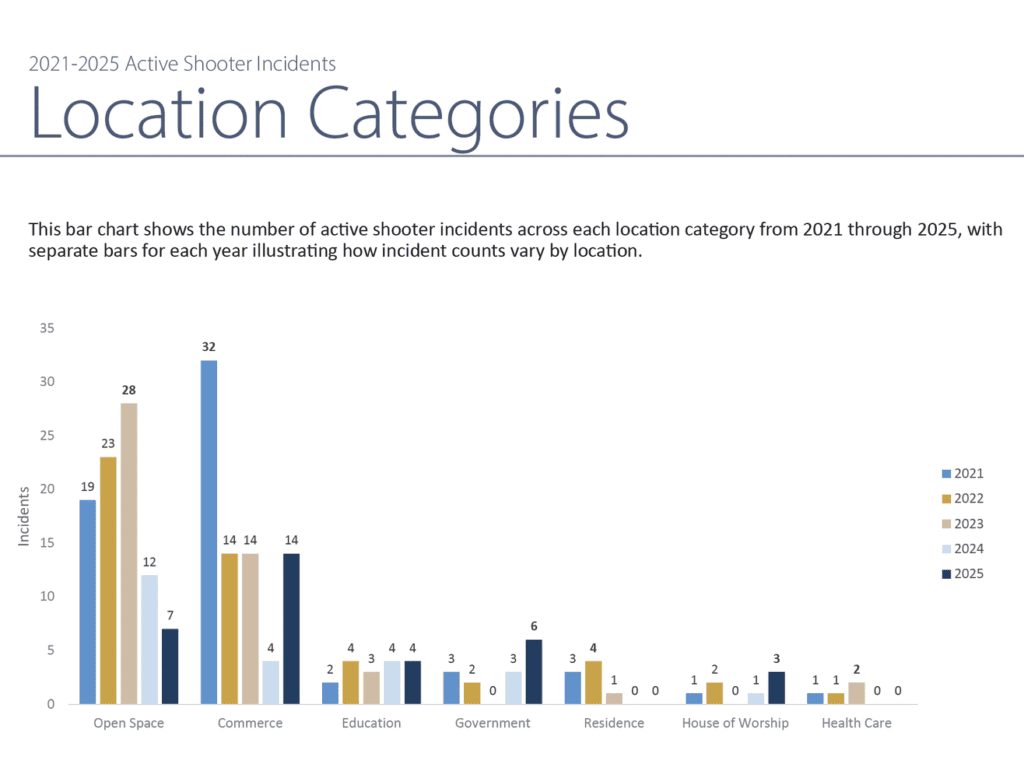
Because schools remain the setting people ask me about most, it’s worth taking a closer look. Four active shooter incidents occurred at schools in 2025—two at universities (Brown University and Florida State University) and two at high schools. There were no shootings at middle schools or elementary schools.
In both high school incidents, teenagers brought handguns to their local schools in Evergreen, Colorado, and Antioch, Tennessee. Both shooters died by suicide at the scene. In Evergreen, two people were wounded. In Antioch, one person was killed, and two others were wounded.
This continues the encouraging trend of schools accounting for fewer active shooter incidents.
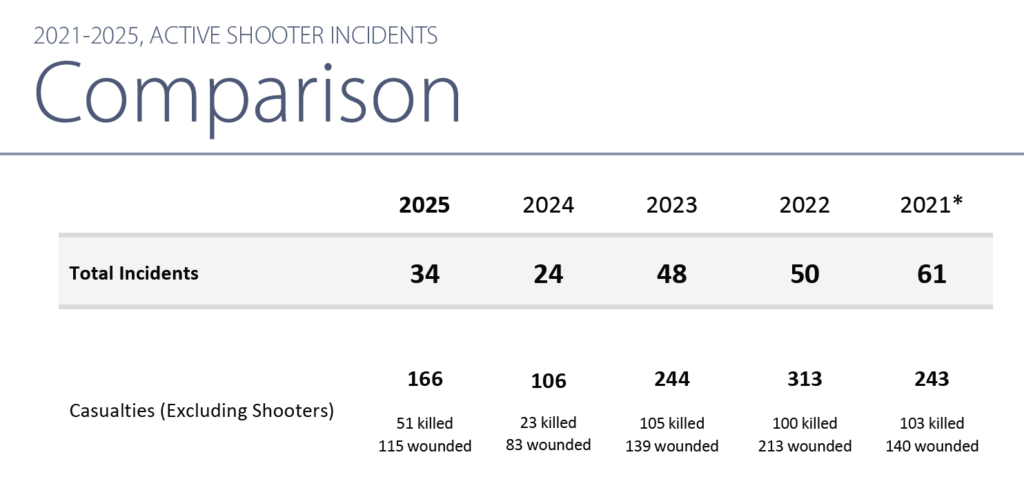
The overall picture, however, is far less encouraging. The report documents a continuing increase in the lethality of active shooter incidents. In 2025 alone, 51 people were killed and 115 were wounded. Despite the extensive training law enforcement officers receive, the dangers they face remain evident: three officers were killed and five were wounded while trying to save the lives of others.
Another finding caught my attention immediately. The threat to houses of worship continues to grow.
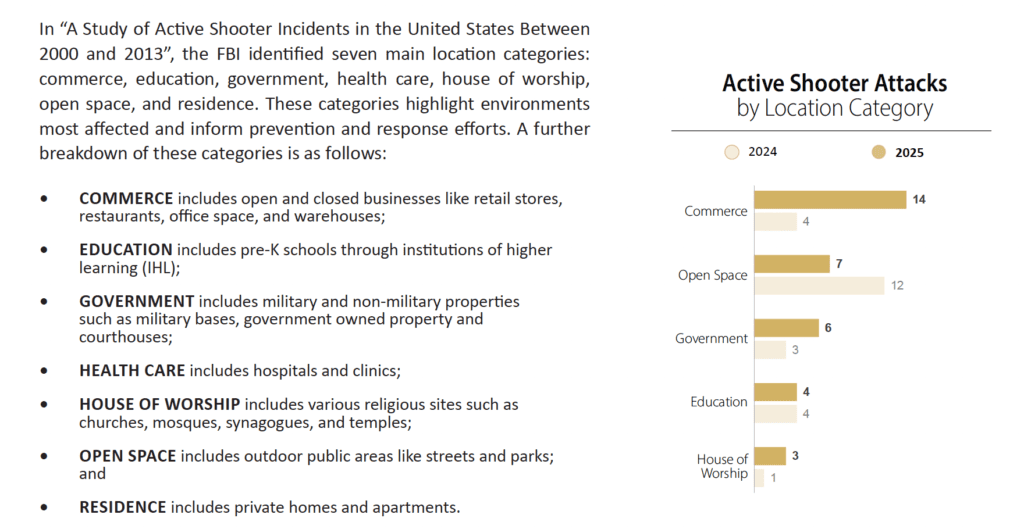
In 2025, four active shooter incidents occurred at houses of worship. Two of them resulted in the highest casualty counts of the year: the shooting at Annunciation Roman Catholic Church in Minneapolis, Minnesota, where two people were killed and 28 were wounded, and the attack at The Church of Jesus Christ of Latter-day Saints in Grand Blanc Township, Michigan, where four people were killed and eight were wounded.
Those responsible for security at houses of worship should take note. When I wrote the FBI’s first Active Shooter Report, we examined 160 incidents spanning 14 years. Just six occurred at houses of worship, resulting in 21 people killed and 27 wounded. In the past five years alone, there have been seven active shooter incidents at houses of worship.
Why is this happening? It’s difficult to say with certainty. Every shooter has a different motivation. But we are living in a more angry and divided country, and religious institutions have long been targets of frustration, conflict, and hate.
Overall, the incidents remind us that active shooters do not discriminate when choosing a location.
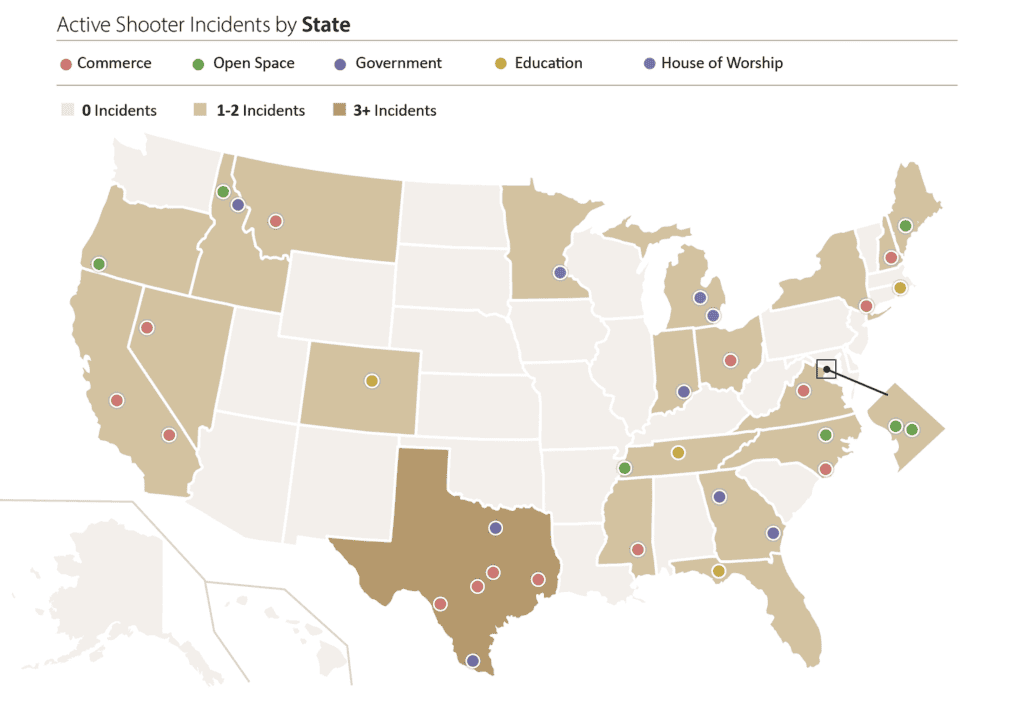
In 2025, they opened fire in an office building on Park Avenue in New York, at a bar in Montana, at a fish company in South Carolina, and at a church in Minnesota. Texas experienced the most incidents, with six shootings accounting for one out of every four deaths nationwide. Every other state recorded one or two incidents.
One caution as you read the report: don’t place too much weight on some of the percentages. At first glance, a 42 percent increase in incidents from 2024 to 2025 sounds alarming. But looking back one more year tells a different story. Between 2023 and 2024, incidents fell by 50 percent, from 48 to 24.
That’s why it’s important to look beyond the headlines and percentages. Read the report for the trends, not just the statistics. Those are the findings that can help us better understand where the risks are changing and where our prevention efforts should be focused.
And, as promised, here’s the finding that concerns me most—and one I fear many business leaders will overlook.The 2025 report shows a frustrating consistency: active shooter incidents continue to occur at places of commerce. In 2025, 14 of the 34 incidents—41 percent—occurred where people work. That isn’t new. The FBI’s first study found that half of the 160 active shooter incidents occurred in workplaces.
Every year, I receive urgent calls from organizations that believed it could never happen in their hallways until it did. Too many businesses are unprepared to recognize the warning signs of disgruntled current or former employees. Even fewer have prepared their people to respond when violence reaches the workplace, whether it begins inside the organization or spills over from outside.
Businesses often view security as a cost center rather than an investment. I understand the pressure to balance budgets and priorities. But I’d encourage every business leader to use the rest of 2026 to take advantage of the many free resources available to educate themselves and their employees. Small, practical steps taken today can reduce risk, strengthen preparedness, and save lives tomorrow.